
“If You Spook at It, You Get to Wear It”
On flooding, desensitization, and the relationship we build around fear
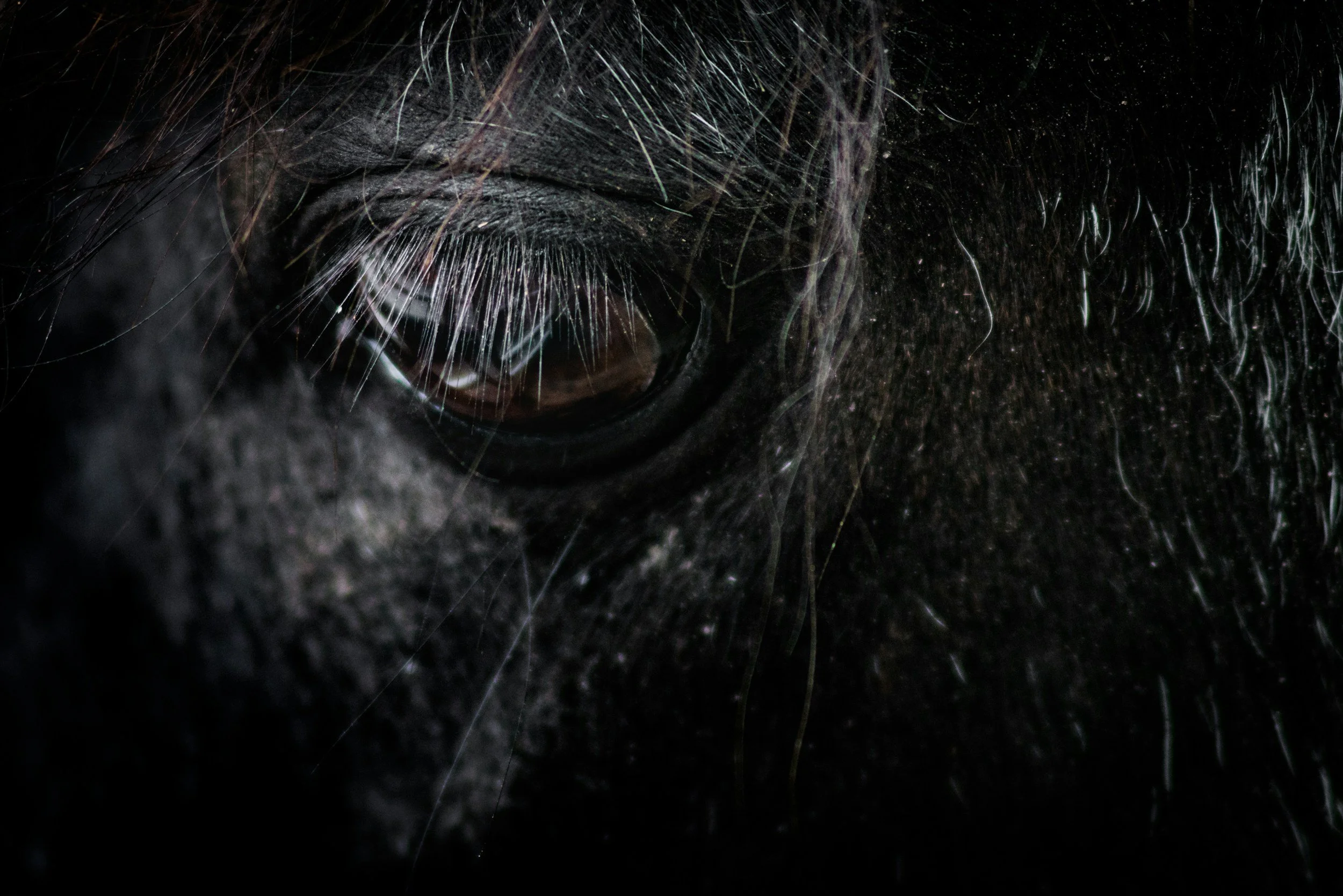
I recently saw a post about a horse wearing a pool noodle attached to his halter. When someone asked why, the owner explained that he was a sensitive guy and they were getting him used to things. Another person recognized the practice: “If you spook at it, you get to wear it.”
That sentence has stayed with me. It is often offered as a joke, or as practical horse wisdom. To me, it reveals an assumption worth challenging: that a horse’s fear is a problem we can solve by making the horse endure the very thing that frightens them.
I understand the goal. We want our horses to be able to encounter strange objects, sounds, movements, and sensations without panic. Their safety and ours depend on it. But getting used to something describes an outcome; it tells us very little about how the horse got there or what they learned along the way.
And this is where I find myself thinking not only about horses, but about therapy relationships with humans. In both settings, we can become so focused on whether the visible reaction has stopped that we lose sight of the person—or horse—who is having the experience. We may call it progress when someone is quiet, compliant, or no longer protesting. But what if the deeper question is not, Did the response disappear? What if it is, What did this individual learn about fear, choice, and the person beside them?
When desensitization becomes flooding
Desensitization and flooding both involve exposure to a stimulus. The difference is in the intensity of that exposure and whether the individual has room to process it. With systematic desensitization, we begin at a level the horse can manage. We let them notice the thing, pause, investigate, and gradually increase its intensity as their response changes. If they become frightened, that is information to adjust the distance, duration, or difficulty.
Flooding presents the frightening thing at an intensity the horse cannot manage and continues the exposure until the visible reaction stops. When the object is tied to a halter, the horse may have no way to create distance from it. A practice described as “desensitizing” can cross that line in a moment: the horse spooks, and instead of making the situation more manageable, we fasten the object closer.
The label does not make the method gentle. The horse’s experience matters more than what we call it.
I also hear a punitive message in “if you spook, you get to wear it.” Whether the person intends punishment or not, the horse’s fear response is followed by an inescapable increase in contact with the feared thing. We cannot assume the horse understands a human lesson such as I should choose not to spook next time. A spook is a protective response, not a considered act of defiance.
Therapy can carry a similar risk. A client may be encouraged to stay with an experience, disclose more, feel more, or revisit something painful before enough safety and capacity are present. The therapist may understand the intention as helping the client move through fear. The client may experience it as being unable to slow down, step back, or have their signals change what happens next.
Exposure is not automatically healing. It becomes meaningful when the individual has enough support, choice, and capacity to remain engaged with the experience rather than simply endure it.
Stillness is not enough evidence of safety
A horse might initially startle, pull away, raise their head, tighten their body, or search for an exit. Then, after a while, they stand still. We may say, See? He got over it.
Maybe the horse did learn that the object was harmless. But stillness alone cannot establish that. A horse can stop moving while remaining physiologically aroused, braced, or unable to influence what is happening. In a study comparing approaches to a frightening stimulus, researchers found that heart-rate variation persisted even when visible behavioral responses had stopped. We have to be cautious about equating the end of protest with the end of fear.
I am not diagnosing “learned helplessness” from a short video or saying every quiet horse is shut down. That would be another way of ignoring the individual in front of us. I am saying that shutdown and override are possibilities we should take seriously, especially when restraint, repeated fear, and the absence of a workable exit are part of the method.
What if the horse has learned less about the noodle and more about us? My signals do not change what happens. The person will keep going. The safest available response is to stop showing how I feel. That is a possible lesson, and it is one I do not want to teach.
In therapy, a client may also become quieter, more agreeable, or less visibly distressed. That change might reflect increased regulation. It might also reflect appeasement, dissociation, resignation, or a decision that honesty is no longer safe in the room. The therapist cannot determine the meaning of stillness by looking only at behavior. We have to remain curious about what the person’s quietness is communicating.
A client who stops objecting may not be telling us, This feels safe now. They may be telling us, I have learned that my objection will not change the pace.
There are two nervous systems in this encounter
When a horse spooks, something often happens in the human body, too. We may feel a jolt of fear, embarrassment, irritation, or urgency. We may imagine a future accident or hear an old instruction to “get control” before the horse gets worse. Our shoulders tighten, our breathing changes, our hand shortens the lead rope, and our attention narrows to stopping the visible behavior. The horse is responding to an unfamiliar object while also experiencing us.
This is where the somatic work begins for the human. Can I notice my feet on the ground and the pull in my hands? Can I look around, exhale, and recognize that I have time to choose a response? Can I create enough space for both of us to orient? My steadiness does not magically regulate a frightened horse. But if I can notice my own state, I have a better chance of offering clear, less pressured information instead of adding my alarm to theirs.
The same is true in the therapy room. A client’s fear, anger, withdrawal, or uncertainty can activate the therapist’s own nervous system. We may feel pressure to fix, reassure, interpret, challenge, or prove that the session is moving forward. We may become subtly more directive because the client’s distress is difficult for us to tolerate.
The client is not only experiencing the content of the conversation. They are also experiencing our pace, our tone, our posture, our willingness to pause, and whether their signals have any effect on the relationship. The therapist’s regulation is not a magic intervention, but it can create more room for the client to remain present and participate in what happens next.
In The Language Between, I return to a simple question: What conditions make a meaningful response possible? Can the horse see and investigate the thing? Is there room to move or turn away? How much pressure is already present from the halter, the setting, or the person? What is happening in my body as I make the request? A horse who cannot leave or slow the interaction may still comply, but compliance tells us very little about how they experienced it.
The same question can be asked of a client: Do they have enough safety to notice what is happening inside? Can they slow the conversation? Can they disagree with me? Can they say, “I do not want to go there today,” and trust that the relationship will remain intact? Are we inviting a meaningful response, or are we asking for compliance while calling it therapeutic progress?
This is a conversation, even when neither of us uses words. The horse looks, pauses, steps back, approaches, braces, or softens. The human notices and adjusts. A client may change posture, lose eye contact, become more animated, go quiet, laugh, intellectualize, or say something that seems unrelated. The therapist notices and adjusts.
If the horse’s response never changes our pace or our plan, we are asking for obedience while calling it a relationship. If a client’s signals never change the pace or direction of therapy, we may be doing something similar. The relational question is not whether the horse or client will accept everything I introduce. It is whether I can remain responsive when they tell me, This is too much, too soon.
What if it is not about the object?
Sometimes a horse seems to spook at everything: a tarp today, a sound tomorrow, a change in the light on a familiar path. It can be tempting to make a list of scary objects and start desensitizing the horse to each one. But if the fear keeps showing up across situations, I want to ask a wider question: Does this horse feel safe with me when something unexpected happens?
That question is not an accusation, and it is not a diagnosis. Pain, sensory differences, previous experiences, the environment, and many other factors can contribute to a horse’s vigilance. Those possibilities deserve attention, including veterinary assessment when the pattern is new or persistent. But the quality of the human–horse relationship belongs in that inquiry, too. Does my presence help the horse find their bearings, or do I become another source of pressure when they are uncertain?
Therapy asks a similar question. When a client becomes overwhelmed across many topics, it may be tempting to focus on the content of each fear: the relationship, the workplace, the family conflict, the memory, the symptom. But sometimes the deeper issue is not only what the client is encountering. It is whether they feel safe enough in the relationship to be uncertain, affected, or honest.
If the horse does not yet trust that I will hear a small sign of discomfort, adding more exposure exercises may miss the deeper work. I may need to step away from the object altogether and rebuild the everyday conversation: spend time together without a task to accomplish; make requests the horse can understand; notice a hesitation before it becomes a spook; allow a pause to actually change my plan. Over many ordinary interactions, the horse can discover that staying connected with me does not require overriding their own body.
A client may need something similar. Before asking them to revisit painful material, we may need to strengthen the ordinary experiences of collaboration: checking in, naming the pace, repairing misunderstandings, making room for disagreement, and demonstrating that “not today” is a complete answer. Safety is built not only during dramatic moments of exposure, but through repeated experiences of being heard in small ones.
This is the relational foundation I care about in The Language Between. We cannot demand trust as a performance or manufacture it by putting a horse—or a client—through enough frightening things. We can become more trustworthy in the moments when their response is inconvenient to our plan.
What carries into the next interaction?
This matters well beyond one noodle. A horse who appears fine in a controlled exercise may still feel overwhelmed when a similar object appears somewhere new, moves differently, or catches them by surprise. The horse may also become wary of the person, the halter, or the situation in which the exposure occurred. These are risks, not outcomes we can declare from a single post.
Think about what we ask of horses later: to meet an unexpected sound on a trail, tolerate necessary care, move with us through a new place, or respond while we are riding. I want a horse who can notice something frightening, remain able to think and move, and find useful support from the human beside them. Training for that requires more than making the outward reaction disappear. Suppressing the early signs of discomfort can leave us with less information about when a horse is nearing their limit, including under saddle.
In therapy, the next interaction matters just as much. A client may appear to tolerate a difficult conversation and then become more guarded in the following session. They may stop bringing up certain topics, agree more quickly, or avoid asking for what they need. The immediate session may look successful while the relationship becomes less honest.
As a trauma therapist, I see a parallel in the way people sometimes mistake outward compliance for felt safety. I do not need to claim that a horse experiences a pool noodle as a human experiences an assault for the ethical question to matter. Nor am I arguing against exposure as a whole; carefully paced exposure can support learning. The question is whether the individual has enough capacity and influence in the moment to learn something new, or whether we are simply requiring them to endure it