
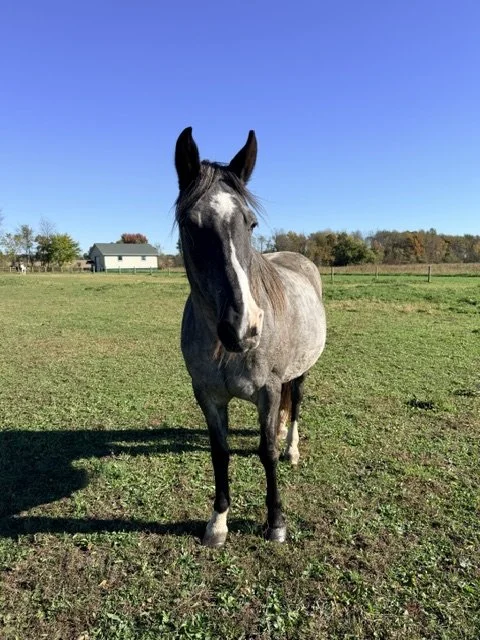
What Rainey is teaching me about compliance, nervous-system capacity, and the language between us
Recently, I was moving stall mats while my mare Rainey stood nearby. I was shifting them only a few inches at a time. To me, the movement and sound were ordinary—rubber scraping against the floor, nothing particularly loud or dramatic.
To Rainey, they were not ordinary at all.
Every small movement sent a wave of fear through her. She rushed out of the stall, and once activated, every sudden motion seemed to send her nervous system toward the roof. I went outside with her, helped her settle, and invited her back toward the barn. She calmed, reconnected, and eventually chose to return.
If this had been the only time I had seen such a response, I might have explained it away as a horse encountering an unusual combination of sound, movement, and vibration in a confined space. But this was not an isolated event. It belonged to a pattern I have been slowly learning to recognize.
Rainey came to me with an impressive history. She had been represented as a roughly $30,000, fully trained “trail horse deluxe”—a horse who had been ridden by different people, traveled many trail miles, and encountered traffic, parades, and the kinds of experiences we assume create an unflappable horse. I was also told by her current owner that despite that she had spooked on the trail, spun and bolted a short distance, and that her rider had come off. I was able to ride her in the arena when I met her and I knew that there was no such thing as a bomb proof horse. Her previous owner was honest in that she could be ridden but was spooky outside the arena. Since bringing her home what I have met instead is a horse with an extensive training history and a remarkably fragile window of regulation. Rainey is a gorgeous, sweet natured soul who clearly loves people and wants to please. She is curious and intelligent and unsure of humans’ intentions and possible the spookiest horse I have had the pleasure of keeping. She is actually the perfect fit for my work with The Language Between.
Training Tells Us What a Horse Has Learned to Do
Training can tell us that a horse knows how to stand for saddling, follow a rein, move from pressure, carry a rider, cross obstacles, or travel down a trail. It can tell us what behaviors have been installed, rehearsed, and reinforced.
Training alone cannot tell us how the horse experiences those behaviors.
It cannot tell us whether standing still reflects ease or immobilization. It cannot tell us whether the horse is participating, enduring, or waiting for the pressure to end. It cannot tell us how much activation is being held beneath a polished response—or what will happen when one more unexpected thing exceeds the horse’s capacity to contain it.
This distinction is becoming increasingly visible with Rainey.
She can be curious, connected, and remarkably willing. At liberty, she has chosen to follow me and perform behaviors she knows. She can negotiate obstacles and stay in conversation. She is affectionate and relational. She has also shown intense activation around things that might appear minor from the outside: a loud, rattling hay truck; pigs and unfamiliar noises; a fallen post she had seen before; a saddle pad being lifted; a tool, rope, raised hand, or quick movement; and now, a stall mat shifting a few inches.
When she cannot see another horse, her distress can escalate toward panic. Around tack, I have seen her head rise, her eyes widen, her face tighten, her body circle, and her hindquarters move away. These responses matter to me even though I may be able to place the saddle pad on her body. Completing the task does not erase the conversation that occurred while it was happening.
A horse can permit something because she feels safe enough to participate. A horse can also permit it because she has learned that leaving is unavailable or ineffective. From the outside, both horses may appear to be standing still.
Those are not the same experience.
The Explosion May Not Have Come From Nowhere
I cannot know exactly what happened in Rainey’s life before she came to me, and I do not want to invent a history of mistreatment simply because she is sensitive. She may be naturally vigilant. She may have experienced pain or discomfort. She may have learned through pressure, repetition, or restraint that the expected response was to continue performing regardless of what happened inside her. Most likely, what I am seeing reflects more than one influence.
It is entirely possible that everything said about her experience was technically true. She may indeed have carried riders safely over many miles. She may have stood quietly for tacking and traveled through traffic and parades. But exposure and experience do not automatically produce regulation. Repeatedly completing a task does not prove that the nervous system feels safe while doing it.
This gives me a different way to understand what may have happened on the trail.
From a rider’s perspective, a horse who suddenly spins or bolts can appear to have reacted “out of nowhere.” But what if the horse had been communicating long before the visible explosion? What if small signs of tension, vigilance, freezing, or overwhelm had been interpreted as obedience—or had become so familiar that no one noticed them anymore? What if the spin was not the beginning of the conversation, but the moment the horse could no longer contain it?
This does not mean a rider caused the fall, nor does it allow me to know exactly what Rainey experienced that day. It does ask us to reconsider the story that a trained horse who completes a task must therefore be comfortable, regulated, and safe.
Sometimes the explosion is not an absence of prior communication. Sometimes it is what happens after quieter communication has repeatedly failed to change the conditions.
The Relational Field Changes What We Can See
In The Language Between, I teach that behavior does not arise from the horse alone. It emerges within a relational field: the horse, the human, the environment, the request, the available choices, the existing pressure, and the condition of each nervous system.
The question is not simply, “Will the horse do it?”
We also have to ask:
What conditions are shaping this response?
Can the horse orient, pause, move away, and return?
What happens in the horse’s body before, during, and after the request?
Is the horse becoming more organized, or progressively more overwhelmed?
Does stillness contain softness and responsiveness, or tension and endurance?
What happens in my own body when the horse hesitates?
Do I become urgent, controlling, disappointed, or determined to complete the task?
Am I listening for a meaningful response, or only for agreement?
These questions change the meaning of training. The task itself becomes less important than the quality of participation within it.
This is also why reducing restraint can reveal more rather than immediately create calm. When a horse is no longer tightly controlled, they may begin expressing what restraint previously concealed. Movement, avoidance, circling, leaving, and refusal are not necessarily evidence that the relational approach is failing. This may be the first honest information we have received.
Rainey may look less “trained” in an environment where she is allowed to communicate. But I may finally be meeting the horse who has always existed beneath the training and I whole heartedly welcome that!
Our Plan Is Not to Make Her Tolerate More
For now, I am not riding Rainey. Our first phase is intentionally non-mounted—not because she lacks riding skills, but because riding skills are not the question currently in front of us.
Our work is to build connection, choice, orientation, recovery, and a shared language.
Sessions will remain short, with one primary challenge rather than multiple demands layered together. With the saddle pad, saddle, and girth, I will work in brief, reversible steps: show, approach, pause, retreat, and allow her response to shape what happens next. The goal is not for Rainey to stand motionless while I complete a sequence. I am looking for curiosity, responsiveness, softening, reorientation, and the ability to remain in communication.
We are approaching separation in similarly small increments: move a short distance away from the herd, pause, reconnect, and return before uncertainty becomes urgency or panic. The point is not to prove that she can be alone. The point is to help her experience movement away and return without losing access to herself or to me.
When something startles her, success will not mean preventing every reaction. A living, sensitive horse will react to the world. I will pay attention to whether she can orient toward what happened, remain connected, recover, and make choices again. Recovery tells me more about nervous-system capacity than perfect stillness ever could. I also want to give her enough space and lead line to let her body do what it needs to do to complete whatever wants to happen within safe limits.
Scary objects do not need to be approached or touched simply because I have decided they are harmless. “Not like this” is meaningful information. It may ask me to reduce the intensity, increase the distance, change the conditions, or return another day.
Before considering mounted work, I also want questions about physical comfort, vision, saddle fit, and pain meaningfully addressed. Then I want to see responsive participation with tack, recovery from ordinary surprises, connected movement at varying distances from the herd, and voluntary exploration across multiple settings and multiple days.
There is no honest deadline for this process. There is also no guarantee that Rainey will become the riding horse I expected her to be.
The Gift Does Not Erase the Disappointment
Rainey is, in many ways, an extraordinary teacher for The Language Between. Our work together may make visible the exact distinctions I want people to understand: training versus regulation, stillness versus freeze, compliance versus participation, and performance versus relationship.
But I did not purchase her because I wanted another rehabilitation project. I already share my life with horses who have significant needs. I was looking forward to having one fully trained, ready-to-ride horse whom I could simply enjoy. I did however know that when the opportunity to have Rainey came that there was a chance that this would not be the case immediately.
I am allowed to feel disappointed that this is not where we are, yet.
Making meaning from our work does not require me to romanticize the loss of what I thought I was bringing home. Rainey can be a profound relational partner and a remarkable teacher while also not presently meeting the need I hoped she would meet. Both truths belong.
I could probably restrict her movement, keep another horse close, tack her while tied, insist that she stand, and push through her activation. Her training might take over. She might eventually perform the behaviors expected of her, and from the outside she might once again look like the horse described in the advertisement.
But doing that would require me to override the very communication I am asking others to notice. It would go against the very thing I teach and am so passionate about.
I am not willing to make silence the price of riding her.
What Lies Between Us
Rainey’s story is not an argument against training. Skills matter. Preparation matters. Clear requests and safe boundaries matter. But training is not the whole relationship, and behavioral compliance is not reliable evidence of internal safety.
The deeper work begins when we stop asking only whether the horse can perform and start asking how the horse is experiencing what we have requested.
What becomes possible when leaving is available?
What do we learn when hesitation is not immediately corrected?
What changes when recovery matters more than completion?
What if a horse’s “no,” “not yet,” or “not like this” is not the end of the conversation, but part of the language between us?
Rainey already knows many things. My task is not simply to make her do them again. Our work is to discover whether those skills can be returned to inside a relationship where her body is information, her communication has influence, and neither of us has to disappear for the other to feel successful.
That may be a longer road back to riding.
But it is the only road I am willing to take with her.
The Language Between is a relational and somatic learning program for people who want to understand what unfolds between horses and humans beyond obedience, dominance, or technique. It explores nervous-system awareness, participation, meaningful response, and the conditions that make genuine communication possible.