
When Relationship Is Reduced to Control: Horses, Humans, and the Cost of Override
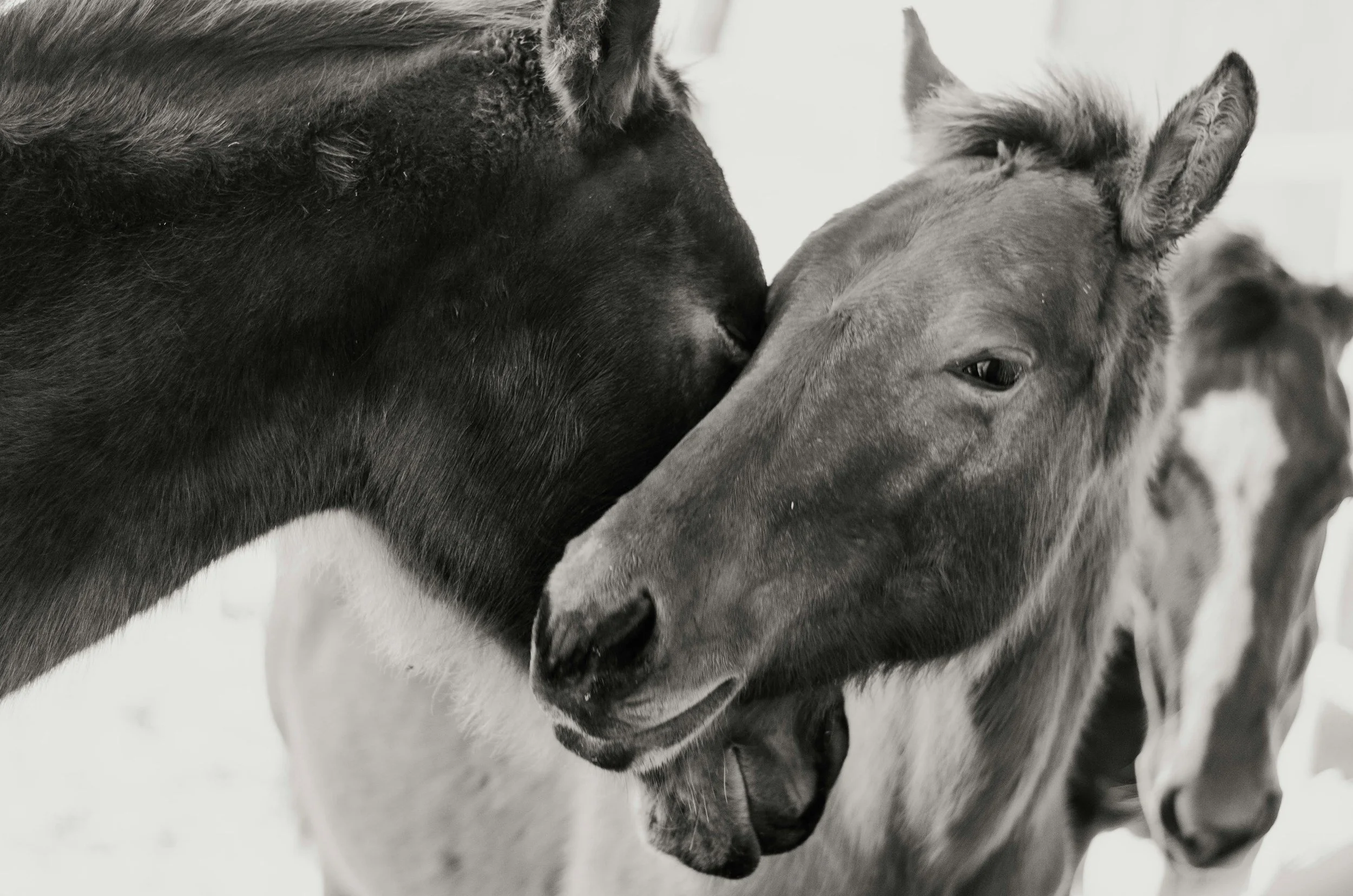
As a therapist, and as someone who lives and works closely with horses, I have come to understand that meaningful healing, real change, and even effective problem-solving do not happen through instruction alone. They happen through relational awareness.
Relational awareness is the capacity to notice and respond to what is happening within us and between us—sensations, impulses, emotions, intuition, thoughts, and behavior—moment by moment and in context. It is how we orient toward safety, truth, and connection. It requires being in relationship not only with the mind, but with the body.
And yet, most of us are taught to override this awareness.
We are taught to distrust our gut feelings.
To ignore bodily warnings.
To push past discomfort.
To “just breathe,” “relax,” “be still,” or “fall in line.”
In the horse world, we are often taught the same thing—both toward ourselves and toward the horse.
Sometimes override is conscious. Often, especially in the presence of trauma, it is an unconscious attempt at survival. Emotional safety, physical safety, belonging, approval, or perceived worth can take precedence over listening to what the body is signaling. Over time, we learn that inclusion may require silence, compliance, or disconnection from ourselves.
The cost of this disconnection is high.
Override as Culture, Not Accident
In a world that frequently values groupthink over critical thinking, and compliance over authenticity, override becomes normalized. When falling in line is rewarded more than asking questions—when expression, emotion, and vulnerability are discouraged—we begin to lose our ability to locate ourselves. We struggle to know what is true in our bodies.
This does not remain an internal issue.
We see the impact ripple outward into our relationships with others, with the land, and with the more-than-human world—including horses, animals, plants, and ecosystems. How we relate to power, difference, and discomfort in one domain inevitably shows up in another.
Across many systems of harm—interpersonal, institutional, cultural, and equine—we see the same pattern repeated:
The one being harmed is told they are not being harmed.
Witnesses are told they did not see or hear what they saw or heard.
Discomfort is reframed as “necessary,” “for their own good,” or “part of the process.”
Those in positions of power insist they know best.
This is not incidental. It is how control sustains itself.
Over time, this erasure teaches both humans and horses that their internal experience is unreliable—that their body’s knowing cannot be trusted. This is a deeply traumatizing process, even when it is subtle, and even when it is wrapped in well-intentioned language.
Bodies do not lie.
But they are often silenced.
Why Cognition Alone Is Not Enough
Before we can make different choices—for ourselves or for the horses we care for—we must return to our embodied center.
Someone can verbalize what they agree to.
They can explain what should happen.
They can articulate values, intentions, and insight.
But verbal agreement does not equal embodied consent.
What actually matters is whether the body has the capacity to participate. Change cannot occur without attending to the body’s response—without feeling, not just processing, what is happening. This is why we can rationalize endlessly and still remain stuck. Insight does not automatically translate into action.
This is also why directives like “just breathe,” “relax,” or “be still” so often miss the mark. Without examining what those commands feel like in the body—without curiosity about history, nervous system state, and context—they become another form of override.
We see this clearly in the horse world.
Command Is Not Relationship
We often say we want horses to feel safe.
We talk about respect.
We say we value partnership.
And yet, we frequently attempt to command these qualities through behavior.
We demand stillness without attending to fear.
We ask for movement without acknowledging overwhelm.
We seek compliance without examining conditions.
Safety cannot be commanded.
Trust cannot be trained into existence.
Relationship cannot be forced.
When training becomes primarily about eliciting obedience—about suppressing expression, micromanaging bodies, or demanding submission—it ceases to be relational. It becomes a one-body system in which one nervous system controls another.
We need to ask ourselves honestly:
Is this what we mean by relationship?
What kind of healthy relationship—human or horse—has ever been built on one body training another to perform solely according to one party’s desires?
History answers this question clearly.
Re-Entering Relationship Differently
Healing past relational conflict or trauma—whether with humans or horses—is not about becoming passive, permissive, or disengaged. It is about developing the capacity to stay present with sensation, impulse, and truth, even when that truth disrupts familiar systems.
This requires slowing down.
Listening beyond behavior.
Examining conditions rather than demanding outcomes.
When we take time to reflect on and heal past relational ruptures—force, fear, betrayal, misattunement—we are able to re-enter current relationships differently. We stop trying to control connection and begin to participate in it.
The journey from cognition to attunement to embodiment is a long one. This is why patterns repeat. Not because the person or horse is “being difficult,” but because something in the relational field has not yet been addressed.
We cannot train relationship into existence.
We cannot force connection through technique.
Calling Things What They Are
If what we want is control—in the name of money, sport, productivity, or image—then we need to call it what it is.
Not leadership.
Not respect.
Not partnership.
Control.
And when harm is named and nothing happens, that inaction is not neutral. It protects the system as it is. Silence, in these moments, is participation.
Relationship asks something different of us.
It asks us to return to our bodies.
To stay curious rather than certain.
To honor communication rather than suppress it.
To let connection be co-created instead of imposed.
This way of relating extends beyond horses—to land, to plants, to ecosystems, and to one another. How we practice relationship in one place is how we practice it everywhere.
Relational awareness is not a technique.
It is a way of being.
And from that place, everything changes.